
Issue #5: Learning about lightning, the fish that makes dreams and reflections on beautiful inexpertise
A wandering ensemble of words meandering through a landscape of occasionally lucid themes

TL;DR
The highlight of a recent snorkelling trip was getting stuck in an intense lightning storm and riding it out crouched in a ditch researching what to do if you are trapped in an intense lighting storm.
RAMBLINGS: I’ve been realising how important dreams are as a way of processing stuff out of conscious awareness in a similar way to how therapeutic art does.
ARTICLE: I am starting to miss being a total beginner at backgammon and reflect on the importance and beauty of inexpertise.
WORKSHOP: 14th November - Masks.
BUY: Get your hands on some lovely A3 and A4 limited prints of my globally viral “(Not a) Lost Cat” poster
OPEN STUDIO: Come into my world and visit my studio in Kingston-Upon Thames from 11am-5pm on Saturday 15th November.
MARKETS: I’ve some Christmas Markets coming up. 06th December Illustrator’s Fair in Kings X. 13th December Kazland’s Festive Martket in Guildford, 20th December Surbiton Farmer’s market in Surbiton,
I share a photo of me with a lovely crab on a recent trip as a thank you to all of you who support my work financially. If you would like to, and can afford to, then there are a number of ways to do that: Buy stuff in my shop, become a patron of my studio or buy me a coffee (tip jar).
1. Hello
I had a bad trip in September. Not the kind of bad trip that I had back in my early 20s when I was trying to be Syd Barrett and took too much LSD. But a bad travelling trip.
For the second half of 2025 I’ve been trying to do things that support my mental wellbeing and give myself permission to spend more time being fascinated by the things that fascinate me. So, with this in mind, I decided to book a trip to the national marine reserve of Alonisos in Greece to do a week of snorkelling and spend time being fascinated by sea creatures.
To cut a long story short - it didn’t work out how I imagined it would. The weather in Alonisos was some of the wettest, coldest and windiest they had seen for some time which meant that snorkelling wasn’t possible for most of the week I was there. And because the weather was so bad the islanders had decided to shut down early for the winter meaning no boats, no busses and no places to visit to escape from my very small and dark apartment (with noisy neighbours right above). And to top it all off I got a bug or food poisoning on the second day of being there which meant that everything I tried to do had a horrible twinge of sickness to it.
All of this meant that instead of creatures, sunshine and sea, I spent most of the time stuck in my rather oppressive room becoming more and more anxious and plotting ways to come home early. (This wasn’t possible due to weather travel disruption, ferry strikes and not being able to move my flight.) It feels important to say at this point that I realise a “bad trip” of this nature really is a first world problem and I could be stuck in a much worse situation. And, at the same time, as an artist who has little disposable income to spend on things like this and as a human whose nervous system can easily get triggered into a spiral, it personally felt like a very challenging experience.
In the end I decided to abandon Alonisos and got a ferry to spend the last two days in Skiathos before flying back. The weather in Skiathos deteriorated even further with some of the heaviest rain I have ever seen and crazy thunderstorms. But on the final day before I flew back I woke up to beautifully warm sunshine and only a scattering of little white clouds. I even managed to eat breakfast outside on a little balcony for the first time in the week - something I had imagined doing every day of the trip. I wanted to make the most of this break in the weather so I did some quick research to find out if there was a remote beach I could hike to for one last snorkel. I spotted a place called Nikotsara beach which was about 6km from my Airbnb, packed my stuff and headed off.
The route to the beach was impressive. Once I left the main roads I saw no humans for an hour - only goats, sheep and the occasional dog guarding a scary looking farm. The path wound through some steep hills and down into a narrow tree-lined valley with a stream that flowed into the sea. The beach was exactly what I was looking for. Very remote with no humans for miles. The only problem was that the storm from the night before had churned the sea up so much that it was a bit too rough and murky for snorkelling so, rather than ending the trip with a dissatisfying snorkel, I decided that I would just enjoy sitting on the beach watching the waves for an hour or so.
Nikotsara beach has very steep cliffs either side of it. Huge grey slabs of jaggedy rocks, dotted with trees, shrubs and tufts of grass. As I surveyed the sheer slopes I spotted some mountain goats grazing on an impossible gradient. This fascinated me. These distant creatures weren’t just grazing, they were playing and running and jumping on a surface that I could barely imagine standing up on. It was as I watched the goats that I noticed the clouds descending down the valley. Dark, grey clouds that told me I was going to get very wet, very soon. Then, out of nowhere, there was a bright white flash of lightening and an almost instantaneous clap of thunder that made the goats scarper and a gang of hooded crows caw loudly and quickly fly off to find shelter. Hearing the almost deafening thunder and seeing the animals flee, I came to realise that I was situated on a very exposed beach, next to a huge body of water, surrounded by tall cliffs and trees and the only way to a safe shelter was back up to the top of the hill. I very quickly came to the conclusion that I was stuck and needed to take some sort of evasive action.
More deafening thunder crashed around the cliffs, followed by torrential rain, so I found a little cave-like bit of rock to hide in to try and keep dry and minimise the risk of getting struck by lightning. Creating a tent from my coat I did some phone research to find out whether sheltering in a cave by the sea was a good idea. I found lots of articles suggesting that it was in fact a very, very bad idea so I waited for the next clap of thunder and then scuttled away from the beach towards a clump of shrubs and brambles and leant against an earth bank which seemed like a more sensible thing to do. More under-the-coat phone research told me that this was only a marginally better alternative to the cave. So, as the lightning continued to crackle in the air, I looked for the lowest place possible and scampered into a sand/dirt ditch and adopted the lightning pose - a weird crouch on the balls of your feet with your hands up around your head that is a last resort to minimise chances of a lightning strike passing through your heart! (I admit I didn’t adopt the pose fully - one of my hands was trying to use my phone under my coat to find out more about lightning!)
As I crouched (or cowered) I read that most lightning strike casualties are caused by ground current where the current spreads across the ground (hence why the caves were a bad idea), that lightning often strikes the same place repeatedly (like at the top of the cliffs, which were my path to shelter) and that if lightning strikes sand or sandy soil (like where I was crouching) it creates Fulgurites - weird glass-like structures also known as fossilised lightning. I also read about strange phenomena of sensing lightning forming before it strikes through noticing static charges, buzzing sounds, a smell of ozone and St Elmo’s fire - a weird glow around objects. I became a bit obsessed as to whether I was noticing these things or just being very cold and wet. But most helpfully I learnt about the 30-30 rule for being caught in a lightning storm: seeking shelter if the gap between the flash and the sound is less than 30 seconds (for me it was around 2-5 seconds!) and waiting at least 30 minutes after the last clap of thunder before moving on. Whilst it was helpful to learn all of this it meant that I was crouched in my ditch for over an hour!
But what was most fascinating about this experience was that once I was no longer huddled, soaking wet and looking out for signs of static buildup, this whole incident became the highlight of the trip and I’m not exactly sure why. I’ve told lots of people the story of being on this beach and through doing so have realised that I actually found it incredibly exhilarating, even though there was a chance of death or serious injury. I think a big factor in this was the fact that the imminent danger was a phenomena of nature. I couldn’t create a story about my situation being bad because of the uncaring, unfair or inconsiderate actions of other humans. It was just nature doing what nature does and has done for way longer than humans have existed and I was getting to experience it close up and totally alone. This, coupled with my nerdy interest in wild and crazy weather and finding myself learning more about it, whilst being in the middle of it, felt deeply satisfying. (As I was crouched in the ditch I also recorded some live audio for the podcast version of this edition to help pass the time!)
The fish that makes dreams
Another unexpected highlight of the Alonisos trip was learning some weird facts about a common and unremarkable looking little Mediterranean fish. The fish is a salema porgy, one I recall seeing often in my scuba diving days. They were such a common sight when I dived in warmer waters that I ended up mentally categorising them as some kind of underwater pigeon - so common that they just become part of the background in a way that I no longer paid them much attention. (To be clear, I love pigeons. And salema porgy!)
On the few occasions when I managed to snorkel in Alonisos I saw big shoals of them and decided that they deserved as much of my curiosity as the other rarer species. As I had lots of time sitting in my room feeling ill and utterly bored I did a bit of research and it was when I typed salema porgy into a search engine that the weird and fascinating rabbit hole began to open up.
I learnt that in Arabic these little fish are known as “the fish that makes dreams” due to their hallucinogenic properties. I went on to read that salema porgy (latin name sarpa salpa) were consumed as a recreational drug in Roman times and used by Polynesians for ceremonial purposes. (I gleaned much of this information from this wonderful article in Atlas Obscura.)
But the bit that really grabbed my attention was an account from the Clinical Toxicology Journal about somebody who ate one of these fish in 1994:
“A 40-year-old man felt nauseated about two hours after enjoying fresh baked sarpa salpa on his vacation on the French Riviera. With symptoms like blurred vision, muscle weakness and vomiting persisting and worsening throughout the next day, he cut his vacation short and hopped in the car, only to realise mid-journey that he couldn’t drive with all the screaming animals distracting him. These giant arthropods—mere hallucinations, of course—were the last straw. The man directed himself to a hospital, where he recovered completely after 36 hours. He couldn’t recall a thing.”
There are other stories of people experiencing terrifying hallucinations, all of which seem to involve screaming creatures of some kind. But it seems nobody knows quite why eating salema porgy effects some people and not others making consuming them a bit of an alarming lottery. The freaky fish rabbit hole continued to open up as I looked up other weird effects seafood can have on humans. I learnt that ciguatoxin, sometimes found in reef fish like Baracuda, can cause a type of poisoning with strange effects such as phantom feelings, weeks of mood disturbances and the phenomena of hot/cold sensations being reversed! I also learnt that amnesic Shellfish Poisoning can cause short term memory loss.
Whilst I appreciate these are rare cases and eating sea creatures is generally safe, reading all of this made me extra glad that I am vegetarian as I am somewhat terrified of something like that happening to me. I think it is one of the deepest fears that I have - experiencing a sudden, unexplained change in my perception and thinking I am going crazy and not knowing why. I think I’ve had this fear since I was a child but it was certainly exaggerated by the Syd Barrett/LSD experience I referred to earlier, where I took too much LSD and temporarily “broke my brain”. (I told the full story about this onstage for One Track Minds at Wilton’s Music Hall back in 2019 which you can listen to here.) It was a very scary time not knowing if and when the experience of feeling so mentally broken and paranoid would end. I think it lasted for a few weeks but felt like a lot longer. However, the fascinating thing about this episode of temporary insanity was that it all ended when I had a strange dream.
The contents of the dream are somewhat irrelevant and I don’t know if I could explain them or even remember exactly what happened. But what I remember was having the dream, waking up suddenly with my body full of adrenaline, feeling like something significant had occurred and then noticing that my cognition and perception had dramatically returned to normal. I can only conclude that whatever happened in the dream was my body and brain’s way of processing or experiencing or synthesising something that I couldn’t do consciously in order to restore some sort of healthy balance.
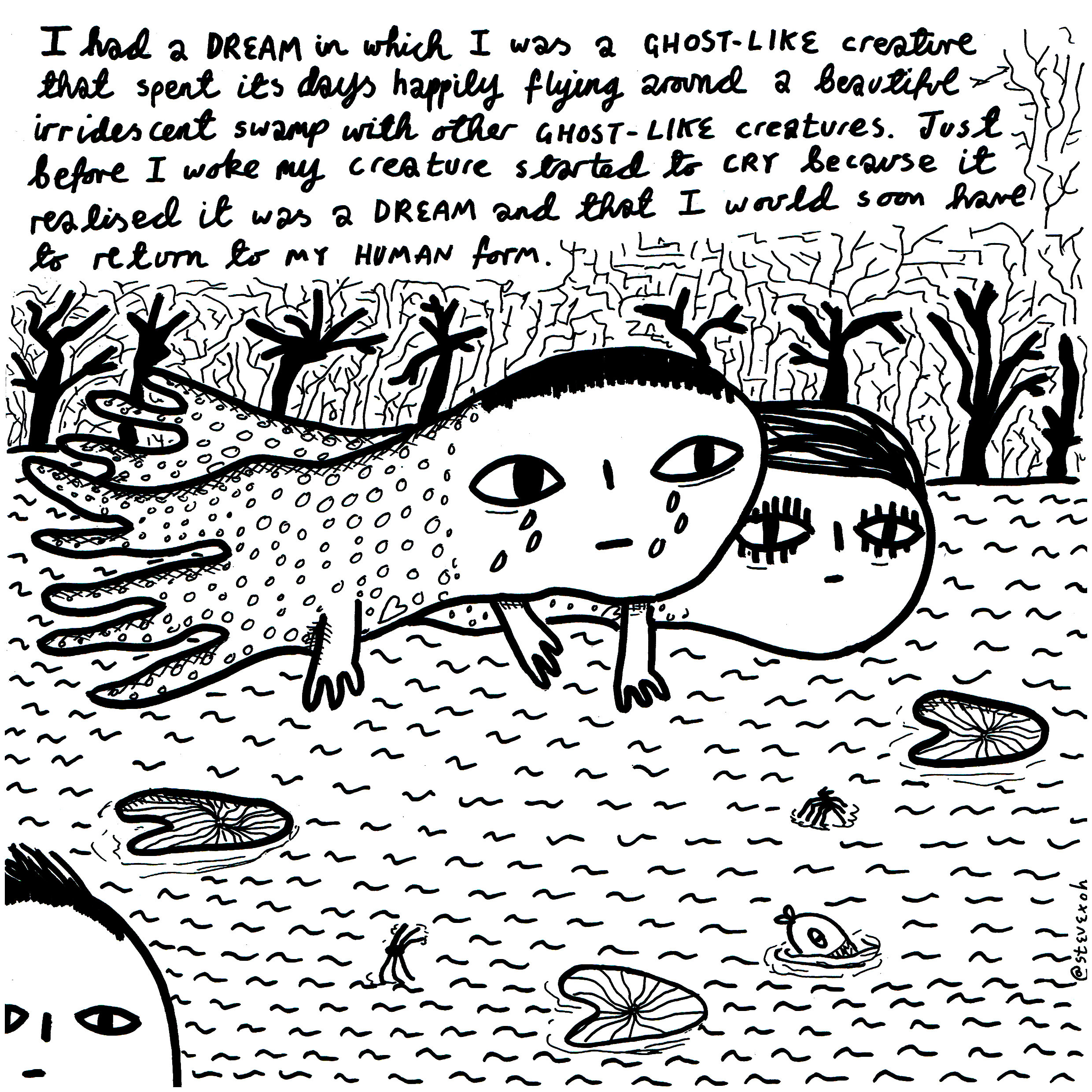
I had a similar dream experience recently. Not related to LSD, which I have not been anywhere near since that incident. But related to some stuff I had been perpetually finding hard in my day to day life - feelings, thoughts and anxieties that felt old and unresolved and manifested in a number of difficult ways. I woke from this recent dream in a much more dramatic way. My body was in deep fight or flight and I genuinely felt like something terrible had happened to me. This feeling stayed with me for a couple of days and only started to dissipate when I wrote the dream down and started to tell others about it. Unusually for me I remembered a lot of the detail of the dream which meant I could reflect on it more deeply. I did drawings from it and wrote down all of the different elements of it - the dialogue, the locations, the characters, the symbols and metaphors. And the more I did this, the more those previously difficult feelings and thoughts dissolved or resolved in some way. I started to realise what I had initially experienced as a very disturbing dream might have been an important cognitive intervention.
Gestalt psychology talks about disorders arising from incomplete gestalts - previous experiences (often from childhood) in which our needs were unmet in such a way that their incompleteness sits undigested in our psyche. These incomplete gestalts can manifest in all sorts of psychological and physical ways and whilst they may resolve themselves naturally, often we need gestalt or other forms of therapy to help process them. So I can only think that this horrible dream was my brain doing the work needed in order to help complete these gestalts and resolve something within me. But beyond this hypotheses I have little understanding of what happened and why it seems to have helped so much. Nor do I really need to.
I experience a similar thing when working 1:1 with others using art, metaphor and rich pictures. I often invite people to make sense of things they are grappling with non-verbally by making marks on a page or paint on a canvas or by squishing a bit of clay or by making a movement. This way of working is an important part of the inner critic workshops I co-facilitate with Simon Cavicchia in which we support others in making sense of and integrating elements of our self-critical super ego. Often in this work somebody will create something and be utterly transformed by it. I’ve seen people sit back and say “Wow! That makes so much sense” or “This changes everything” and all I can see on the page is a series of blobs, lines, squiggles and symbols. The point is that it only needs to make sense to them and sometimes they don’t even know why it has helped.
I’ve started to appreciate that REM sleep must serve a similar function in re-experiencing, integrating, processing, synthesising and resolving sometimes problematic stuff out of conscious awareness. There’s a number of strands of neuroscience research that suggest that during REM sleep the brain replays emotionally charged experiences in a neuro-chemical environment that feels more safe and secure than waking consciousness. In the paper Overnight therapy? The Role of Sleep in Emotional Brain Processing the authors suggest that “REM provides an optimal biological theatre, within which, can be achieved a form of affective ‘therapy’.”
I wonder how many dreams I have had that have done this important work but I have totally forgotten them. And does it really matter that I have forgotten them if the work they needed to do has already been done? I also wonder the the same things about making therapeutic art - does it really need to make sense to anyone other than the artist? And does it even need to make sense to them? In my experience, the point of therapeutic art is the process and not the finished thing.
Arnie Biesser’s paradoxical theory of change has been a big influence on my work. It basically says that we change more through deepening awareness of who we already are rather than striving to be something we are not. What I love about this concept is that it means that there is never any homework to do or actions to complete - the work has been done through the experience itself.
We don’t need to hand in our dreams for marking any more than we need others to evaluate or understand our art. It is just for us, even if we don’t fully understand it.
2. Beautiful inexpertise
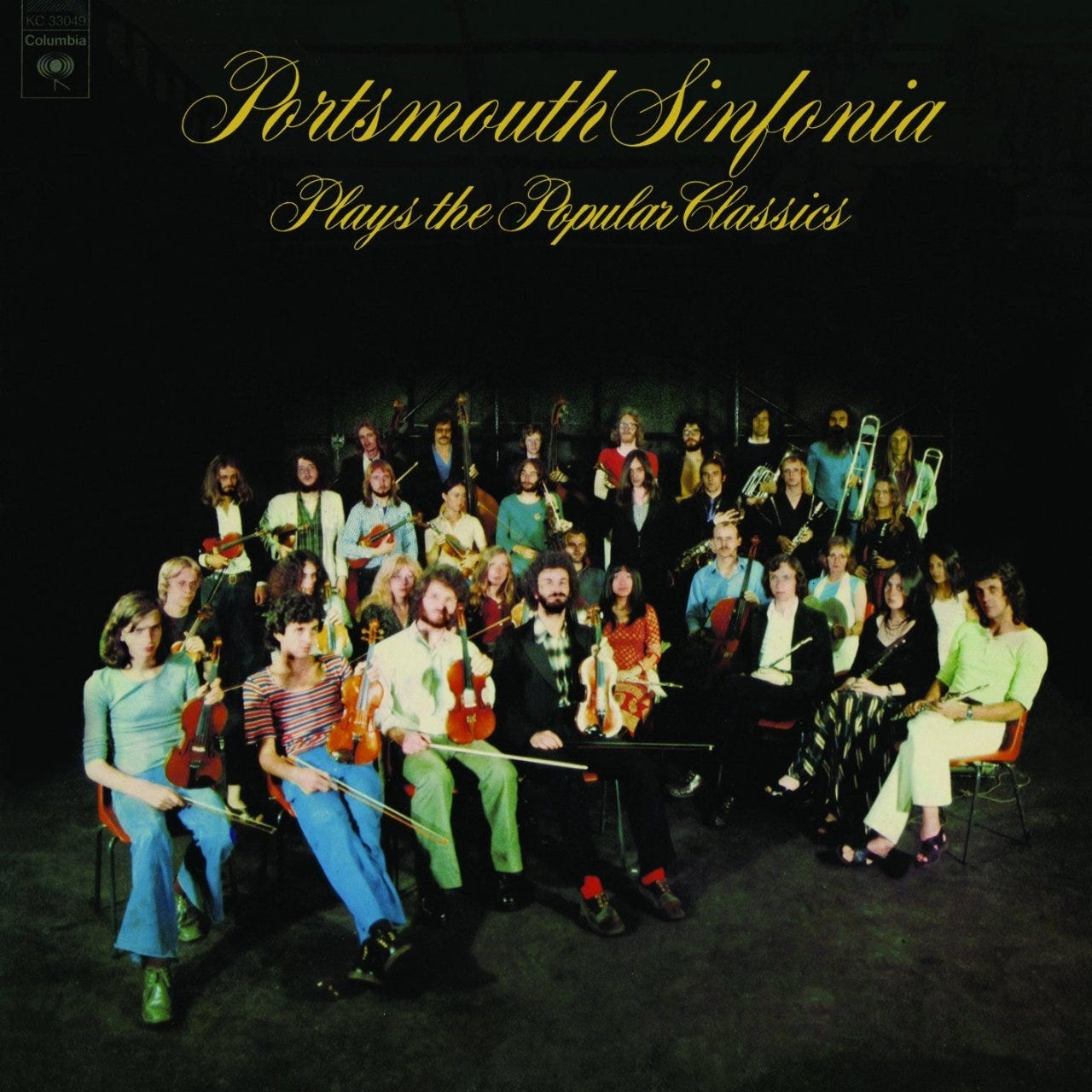
In 1970 a group of students at the Portsmouth School of Art formed an unusual orchestra called The Portsmouth Sinfonia. Anyone could join the orchestra as long as you played an instrument that you had little or no expertise in. Other than that the rules were to show up for rehearsals, try your best and don’t play deliberately badly. The results of this weird experiment were phenomenal as demonstrated in their incredible rendition of Also sprach Zarathustra. But what I find most most fascinating about the Sinfonia’s story is that the more popular they became and the more concerts they played, their abilities accidentally improved and their beautiful, natural-born wonkiness slowly eroded. In the end the Sinfonia disbanded because they got too good! (I tell the story of the Sinfonia in this 2022 talk if you’d like to hear more.)
The story of the sinfonia has inspired me in many ways. It is a cautionary tale of the dangers of inadvertently becoming too accomplished or expert in such way that the edge of not knowing and naive wonder that I find so stimulating disappears. The sinfonia also influenced me directly when I did a weird social experiment called Inexpert back in 2018. Inexpert arose from the curious question “I wonder what the opposite of TED would be?” I have a complicated and somewhat contradictory relationship with TED/TEDx. I’ve done a couple of talks under the brand but also have come to believe that the whole thing has become a parody of itself. The cult of TED seems to have created a particular type of overly-formulaic public speaking that I experience as anything from dull to problematic. So Inexpert was an experiment in flipping the norms of TED just to see what happened.
I’ve long thought that most conferences have it the wrong way round. The norm seems to be that speakers, who are generally regarded as holding a greater level of expertise than those in the audience, go up on stage and demonstrate this expertise in the form of answers, or models or theories. The audience then decide whether that satisfies them or not in an often black and white gladiatorial thumbs up/thumbs down manner. In other words, the audience have a rather passive role in the whole thing.
If I am doing a talk I always consider it my job to make the audience do the hard work. To not try and provide any answers or sense of concreteness, but to simply tell stories in such a way that it coaxes those listening into a space of not knowing. An experience of confusion, surprise and wonder in which they can make their own unique meaning of what I am inviting them to ponder. (Hopefully they also enjoy and are entertained by the stories I tell.) Often people will leave with more questions than answers, but bigger and broader questions than they came in with. (All of this goes some way to explain why my talks are an acquired taste in the tangible, scalable, measurable take-away obsessed corporate world!)
So, on the 11th May 2018 Inexpert happened. I hired a 100 seater Covent Garden theatre and recruited 16 speakers to speak on subjects that they were interested in but had no expertise or experience of. The recruitment process for this was fascinating. Around 100 people applied to the open call and the applications I received fell into three different categories. Firstly, there were people who clearly just apply to every open call! I had applicants proposing they would talk about their new way of thinking about B2B marketing, or give a seminar critiquing agile methodology, or a keynote in which they proposed to share 5 secrets of how to lead in complex times. Needless to say, all of these applications went in the bin. The second category of applicants was fascinating though. Almost 60% of those who applied proposed that they would talk about the importance of inexpertness or about the value of not knowing. These also went in the bin as I didn’t want people to talk about any of this…I wanted them to embody and experience inexpertise live on stage whilst being witnessed by an audience. (I may write more about the phenomena of aboutism in a future issue as it is something that I encounter on an almost daily basis that I think is endemic in creative stuckness.)
The third category was the one that excited me. These were people who seemed to get what I was wanting to experiment with. I remember one guy applied and said “I have always loved robots since I was a kid but I know **** all about them”. I selected him, alongside 15 others who proposed talks on subjects ranging from calculus to looking after a baby to playing tennis. It was important to me that everything about Inexpert embodied inexpertise. For a start, I had never done anything like this before so I had no real idea what I was doing and the John Lyons theatre had never hosted an event like this. I set out to recruit brilliant volunteers to do roles outside the realms of their experience. The person who filmed all the talks had never operated a video camera before. The stage manager had no idea what a stage manager’s role was. The people running the ticket office were brilliant psychotherapists and authors but had never run a ticket office before. But for me the highlight was the inexpert contribution of my friend Nick Parker. Nick is a brilliant guitarist, a deeply experienced writer and a great speaker. But when Nick told me he had been learning to play the trumpet for just six weeks I instantly recruited him to play all of the music for Inexpert live on stage.
The event sold out within a few weeks (it was all not for profit) and on that sunny May afternoon Nick took to the stage to open Inexpert by playing his own rendition of Also sprach Zarathustra - a perfect embodiment of what this weird experiment was all about. What followed was a beautiful and bizarre afternoon. There was laughter, tears, confusion. There was awkwardness, and insight as well as panic and mild physical pain as tennis balls ended up getting randomly hit into the audience. (I had suggested to the person giving a talk on tennis that they should also try to play tennis on stage at the same time to make their talk even more inexpert). But what was most fascinating was that, as all the norms of a conference had been flipped and exploded, new patterns emerged. The normal status dynamics between speaker and audience dissolved as everyone was in this weird space of not knowing together. In fact, the audience felt more anxious and awkward than the speakers at various points. (At one point an audience member felt so uncomfortable that they got up to hug one of the speakers who was giving a long and excruciating talk on nothing, using no words.)
Lots of people wrote blogs and articles about Inexpert 2018 but most said that they could not sufficiently describe the experience other than it was a beautiful and bizarre afternoon of being flawed but willing human beings together. And of course, as the event was considered a success by everyone who attended I was asked several times “When’s the next one going to be?” to which I had to reply “It can never happen again as I have an idea of what I am doing now!”
I learnt from Inexpert 2018 that there is a bitter-sweetness to doing something for the first time. The sweetness comes from that edge-of-the-seat excitement and adrenaline of working it out as you go and learning an incredible amount as you do so. And the bitterness comes from knowing that you can never do that thing for the first time ever again.
All of this came back to me this week as I reflected on the experimental Back Gaemen project I have been doing for the last few months. The intention of this project was to experiment with finding ways of meeting and interacting with new people that felt less socially awkward for me. It has been such a great experience so far - I’ve met lots of people and made some new friends. But one thing I have noticed is that I am accidentally getting better at playing Backgammon, which was never my intention.
At the start of the project I had only played a few games with the old Iranian guy who taught me it in a pub. But at the time of writing this I have now played over 50 games with 18 different people which has meant that my experience level has increased and I am winning more games than I lose. I have come to realise that I really don’t like this. Part of the thrill of the project at the beginning was my genuine lack of expertise in the game. I was inviting people to come into a space of not knowing with me, especially if the other person also hadn’t played before. Even if my opponent was experienced I still got a thrill from losing and experiencing a wonderful kind of backgammon naivety. I am certainly not claiming that I am a backgammon master after 50 games, but I notice a sadness that I am no longer a true beginner. This increase in experience and expertise has changed the nature of the project for me and makes me wonder how much longer I will continue it for.
Malcolm Gladwell famously claimed that people need 10,000 hours of experience to achieve world-class expertise. I’ve no idea how true this is, but what I do know is that I am less interested in the experience of 10,000 hours and more interested in the experience of 10 hours! Ten hours being the amount of time Nick had to practice the trumpet before performing at Inexpert. Ten hours being my first ten sessions of the Back Gaemen project. Ten hours being that beautiful sweet spot that exists between no expertise and just enough expertise to feel safe enough to fully commit to something whilst still experiencing the effervescent creative thrill of the beginners mind.
3. (Not a) lost cat limited edition prints
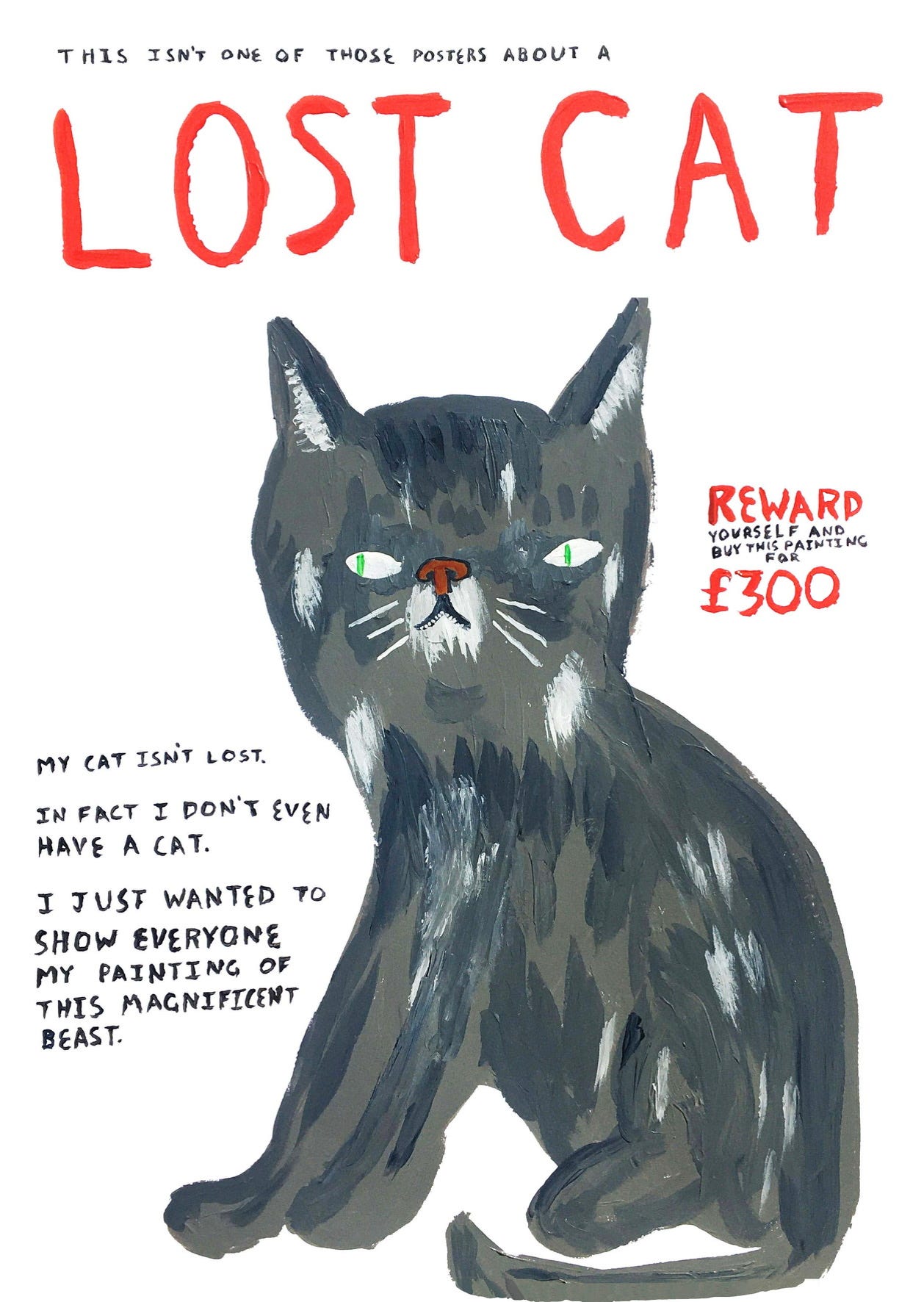
Back in 2021 I spotted a lost cat poster in the woods. Whilst it was sad that somebody had lost their cat I couldn’t help but notice how majestic the picture was of the animal. Tall, proud, slightly cross-eyed. The picture made me wonder whether the cat was actually lost or whether the owners were just showing off what a great cat they had.
When I got home I painted my own version of the poster to stave off boredom for an hour or so. A few days later I took a bunch of posters and put them in random places around London. Surprisingly they elicited a remarkable response with photos of my (Not a) Lost Cat popping up on social media and people asking if they could have a copy to put up somewhere. From that point on the project took on a life of its own with posters spreading across the globe and appearing in 56 countries across all seven continents.
Whilst this has been an incredibly exciting project, it has cost me a lot of time and money and recent changes to international shipping, unfathomable EU custom charges and US import tariffs have started to make the objective of sending free/cheap posters to anyone, anywhere around the world untenable. So this month I decided to end the project intentionally and lovingly rather than let it slowly be suffocated by politics/capitalism.
But, even though the posters are no longer available to buy there are some very lovely limited edition prints of the artwork available in my shop in both A3 and A4 sizes printed on high quality art paper. Only 250 of each size are available and are hand numbered and signed which makes them much more collectable than the original posters. (And I actually make a bit of money from them!)
..:: BUY “(NOT A) LOST CAT” LIMITED PRINTS HERE ::.
4. Open Studio - Welcome to my world
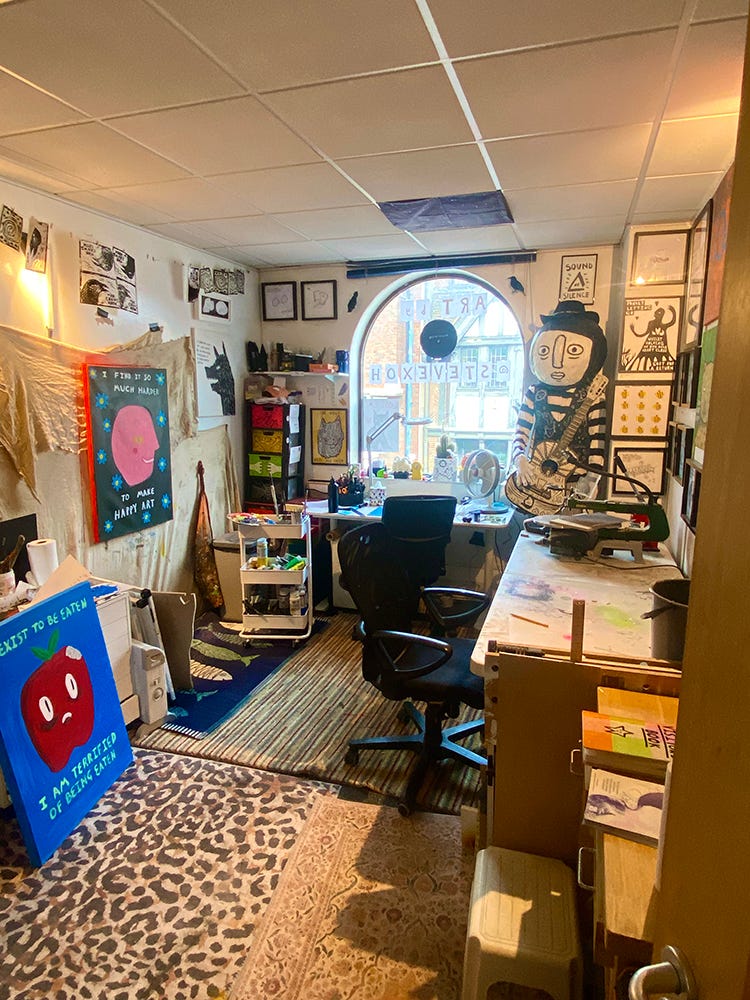
On the 15th November I will be throwing open the doors of Studio Two for anyone who wants to come and visit. This is part of the official Koppel Kingston Open Studio so, as well as coming to see me, you can visit up to 38 brilliant artists in their studios at the same time.
I will have my little shop set up with discounted studio prices for original art, prints, books, t-shirts, badges (etc). Or you can just come and have a look at what I’ve been up to and chat about whatever you want.
There’s no need to book - just show up on the day between 11am-5pm to:
Koppel Kingston
29 Thames Street
Kingston-upon-Thames
KT1 0PH
11am- 5pm
Saturday 15th November 2025
If you would like more info then e-mail me at stevexoh@gmail.com.
5. Markets
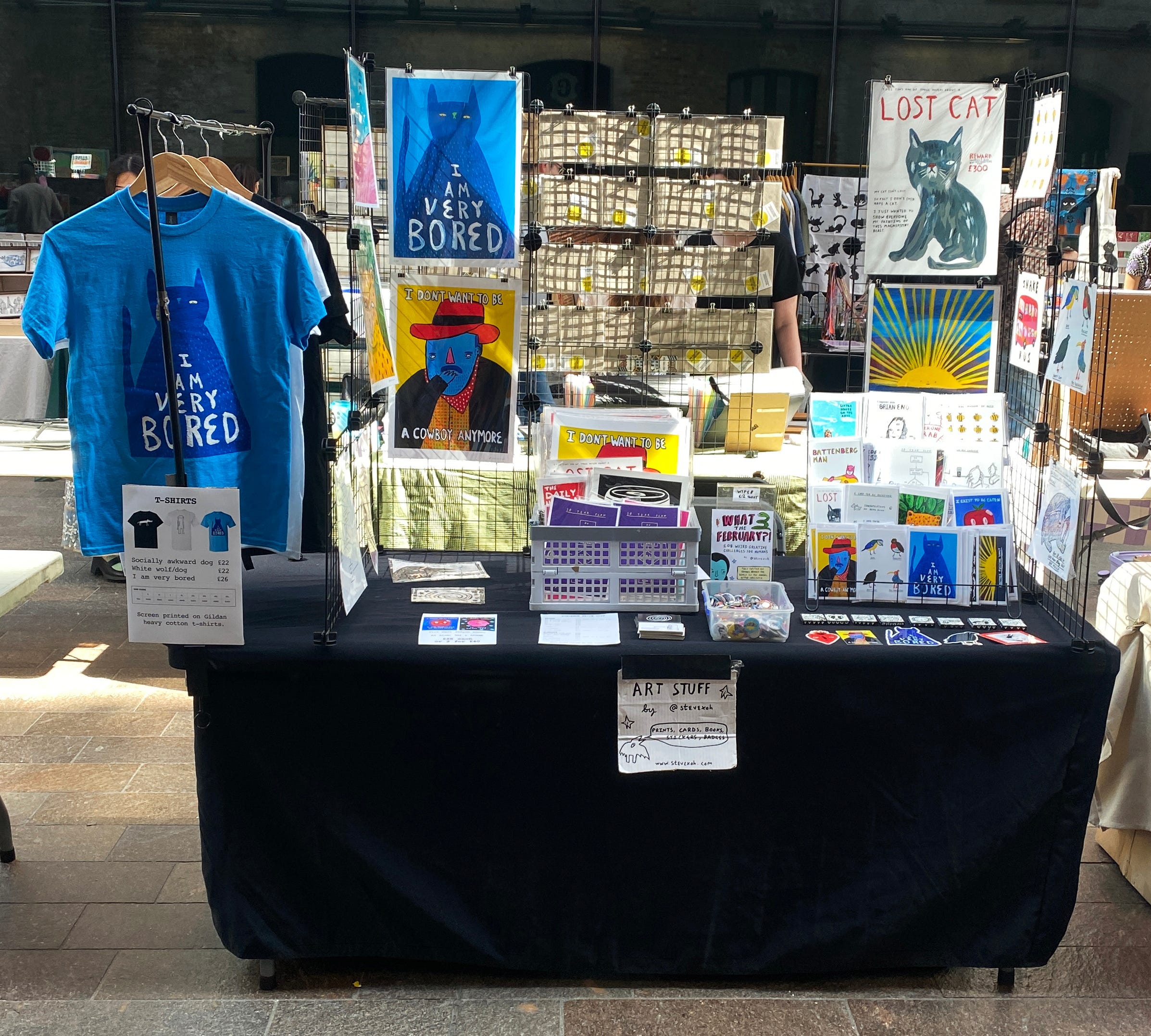
I like doing markets and also find them exhausting. So a couple of years back I decided to only say yes to markets that were cool and interesting. Unfortunately there are a lot of cool and interesting markets, especially around Christmas time, so I have once again ended up saying yes to wayyy too many.
If you’d like to come along and visit me at a market and buy some unique festive gifts then here’s where I will be.
Saturday December 6th: Illustrator’s Fair
Kings Cross, London
.:: MORE INFO ::.
Saturday December 13th: Kazland’s Art Martket
New House Art Space, Guildford, Surrey
.:: MORE INFO ::.
Saturday December 20th: Surbiton Farmer’s Market
Maple Road, Surbiton KT6
.:: MORE INFO ::.
6. Workshops
Just the one workshop left for 2025 and there’s only a few places left on it. I’m working on new dates for 2026 and will hopefully have a load more to tell you about soon.
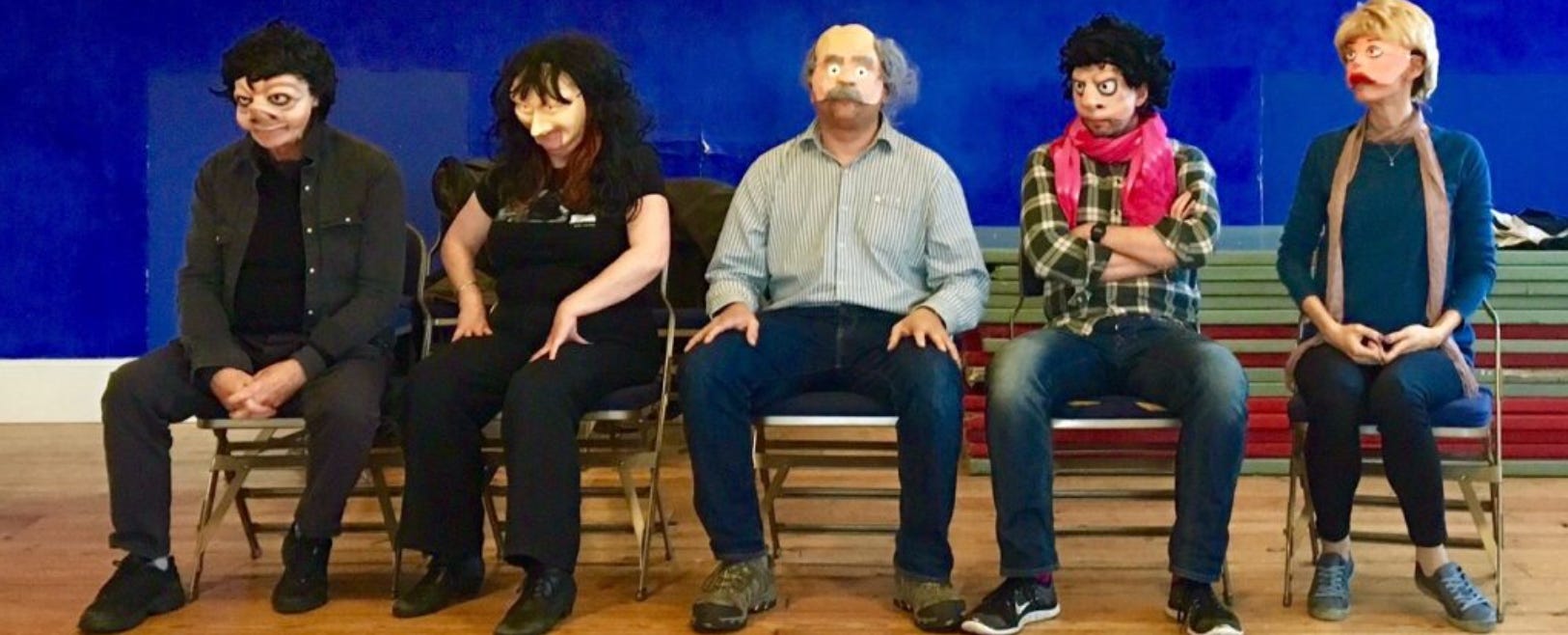
Mask Workshop
14th November 2025
Bloomsbury, London
£130 + VAT. Limited to 10 attendees. (ONLY 3 PLACES LEFT)
This is my absolute favourite workshop to run - so much so that I can only do them four times a year as they are so brilliant and intense that I need to lay down for a few days afterwards!
Basically it is a day of using masks to explore parts of our personality that we have lost touch with or didn’t know existed. We will spend the morning getting to know different masks and the afternoon putting them in different playful and bizarre scenarios and situations.
Previous participants say:
“It is like getting access to un-owned or repressed parts of your personality”
“Simply the best workshop ever.”
“Possibly the most liberating experience you might ever have.”
“I’ll never forget the bits of me I met for the first time at the mask workshop.”
“Very weird. In a very, very good way.”
“A truly magical experience”
“It is like going home with a bunch of new friends inside yourself!”
To keep it playful and intimate the workshop is limited to just 10 places so if you’d like to come along then grab a place ASAP as they sell out quickly.
..:: MORE INFO AND TICKETS ::.
7. Support my work
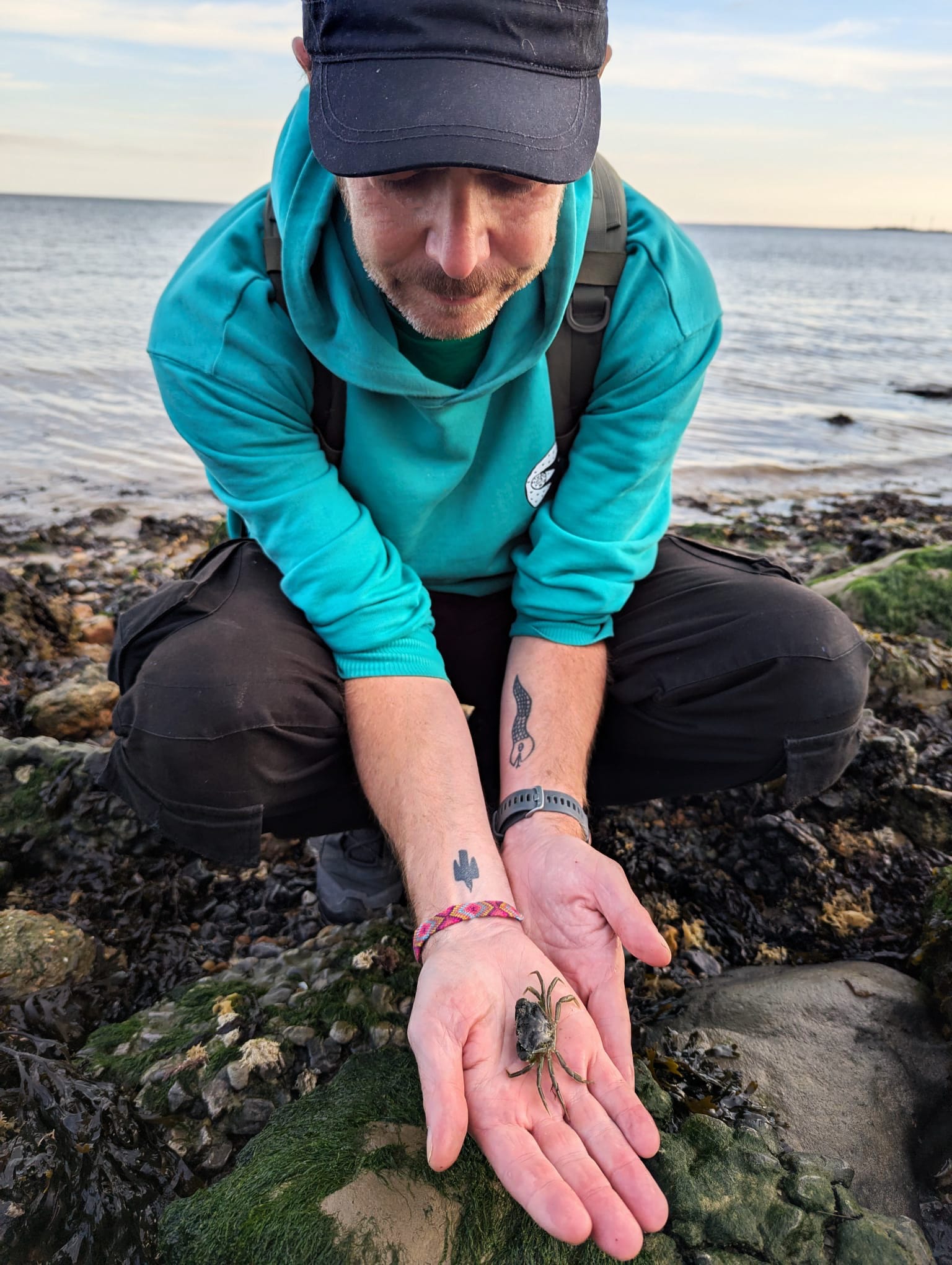
Here’s a picture of me with a crab. I was able to go and visit this crab thanks to the wonderful people who support my work financially.
I write this substack and do my podcast for free as I want it to be accessible for everyone with no additional content or perks for those who can afford to pay. All of my weird projects such as Inexpert, Sound of Silence and the Back Gaemen project are all not for profit and most end up costing me money.
All of which is a waffly and slightly shy way of saying - I need to earn a living so when you support my work financially it means so much. Be that buying me a coffee for £1, buying a big bit of original art or becoming a patron of my studio.
If you would like to and can afford to do this then there are a number of ways you can support my work. (And if you can’t afford it then this Substack will always be free just for you.)
Buy some art from my shop. I have a big selection of prints, original art, books, badges, t-shirts, posters and more.
.:: VISIT MY SHOP HERE ::.Become a patron of my studio. For a one-off donation of your choice you become an official patron with a badge, a certificate, a behind the scenes blog and your name added to the scroll of honour in the window of the studio.
.:: BECOME A PATRON HERE ::.Buy me a coffee. Like a tip jar.
.:: BUY ME A COFFEE HERE::.
Thank you
Steve
❤️🦀
Oh friend, I really felt the pain of your bad trip. I’m sorry it didn’t work out how you were hoping. I loved how you bring so much humour to the lightning situation - felt like I was right there with you. Enjoyed this piece, thank you for sharing 🙏