

TL;DR
I have had the stupid idea to offer analogue versions of this Substack and the accompanying podcast. Get one here.
RAMBLINGS: I see grebes a lot on the river Thames but realised I have never seen their legs which led me to discover that they are in fact a very weird and eccentric bird.
ARTICLE: Everyday technology has had a huge influence on how we perceive memory, so I go down a rabbit hole only to find out if how I think about memory is utterly flawed.
LIGHTING LITTLE FIRES TALKS: I’m excited to be telling stories at this wonderful Stranger Collective event in Cornwall on the 17th September.
ILLUSTRATION FESTIVAL AND TALK: I will have a stall and be doing my bingo machine talk at the Brighton Illustration Festival on the 31st Oct/1st Nov.
WORKSHOP: A two-day “Dancing with the Inner Critic” workshop on November 26th and 27th with myself and Simon Cavicchia.
WORKSHOP: A day of Masks in London on 23rd October.
BUY: Grebo Guru prints and cards.
Photos of two eels I recently met to encourage you to scroll to the end of the Substack and read about how you can financially support my work by Buying stuff in my shop, becoming a patron of my studio, become a paid subscriber or buying me a coffee (tip jar).
1. Hello
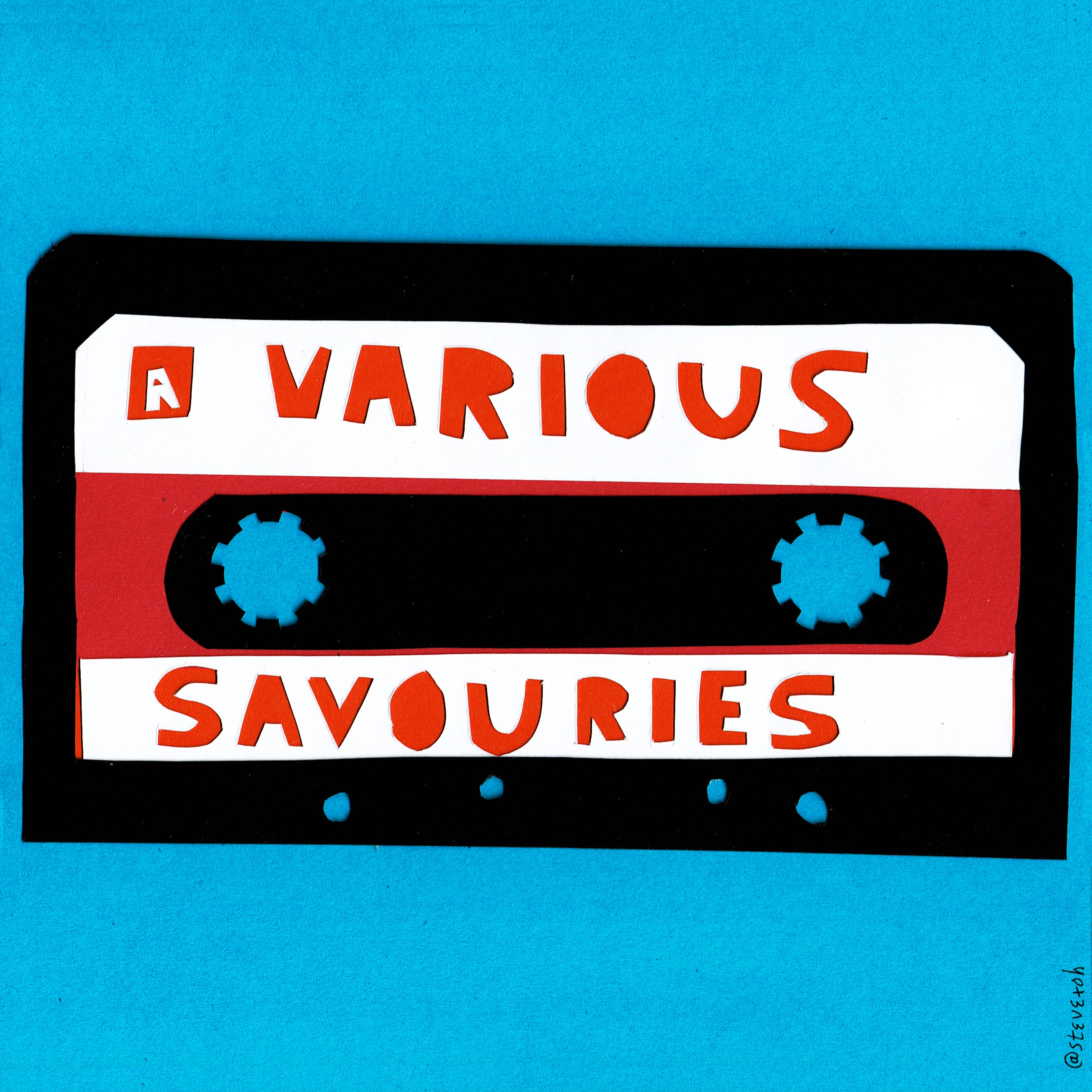
I’ve had the stupid idea of offering an analogue version of this Substack and the accompanying podcast. For a small subscription, I will print out a copy for you on lovely coloured paper, do some doodles in the margins and send it to you via snail mail in a nice old-fashioned Air Mail envelope. For the podcast, I would do the same but with a C90 cassette.
I’ve been toying with this idea for some time and what has made me hesitate is that I cannot eloquently articulate what the point would be. Digital media is so much easier to create and consume. And it is immediate. And it is free. Why would somebody want to pay for something that takes time to arrive and then requires some sort of manual effort to consume? But I guess that is what attracts me to doing it: not knowing what will happen, whether anyone will want it or what it will be like for me to do it.
What I am clear on is that this isn’t a nostalgia thing for me. Like, “Remember the good old days of sending letters and listening to cassettes.” I have romanticised this before, only to realise on digging out a typewriter, procuring a cassette player or writing a letter that there was a very good reason why we embraced a more digital world. The gift of the digital revolution has been to remove some of the tedious friction and manual labour from these processes. But I am curious as to what has also been lost.
Analogue requires a much more active form of participation and engagement with this unavoidable friction. The letter needs to be transported across the landscape, then opened and read. The cassette needs to be taken to a special machine and play pressed (and it needs to be rewound afterwards). All of these tasks require physical movement, the use of motor skills and a certain amount of patience. (It reminds me of what psychologists Robert and Elizabeth Bjork called “desirable difficulties”: the counterintuitive idea that making something easier isn’t always better. Sometimes the difficulty itself is doing useful cognitive work.)
In his book The World Beyond Your Head, author Matthew Crawford explores human attention and suggests that it isn’t simply a thing that we possess, but something that is organised by our environment and the objects within it. These “ecologies of attention”, as Crawford calls them, provide a kind of choreography for our attention, influencing what we notice and how we engage with the world around us. He suggests that the objects within our field of attention “push back in their own intractable ways”. And, for me, this is where an interesting difference between digital and analogue consumption happens. A physical letter will push back in a totally different way to words on a screen. A physical audio tape will push back in a different way to audio streamed from a device. It is almost as though old analogue objects are more steadfast in refusing to adapt to our needs, demanding instead that we adapt ourselves to them. For me, that feels like an idea worthy of experimentation.
So, back to my stupid idea, which, having explored all of this, feels simultaneously less stupid and more stupid at the same time! If you would like to pay to engage with my work in a way that is far less flexible and efficient, and demands considerably more of you in order to consume it, you can sign up here.
The mysterious crested-arse foot bird
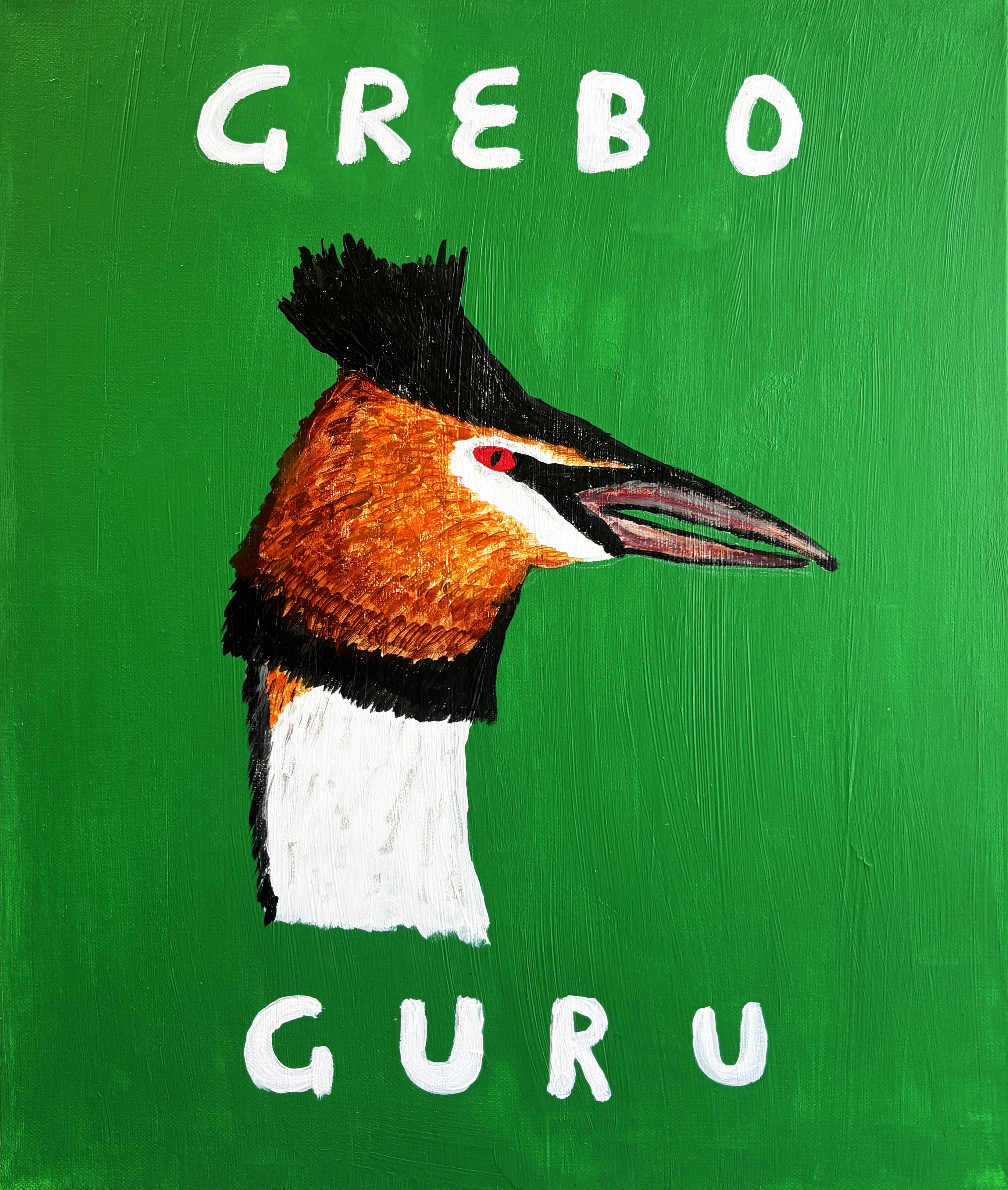
Living by the Thames, I see a lot of grebes. And every time I see one, the 1990s Pop Will Eat Itself song Grebo Guru comes to mind. (Which, if you don’t know it, is a song about 1990s subculture, not common river birds.) This automatic brain connection started to really annoy me, so I wondered if painting a grebe with the words GREBO GURU would exorcise it from my psyche. I’m not yet sure if this worked, but doing the painting led me down a fascinating grebe rabbit hole.
I wasn’t sure whether to paint a whole grebe or just a grebe’s head. So I did some research to find a reference image for a whole grebe and it was then that I discovered the first of many weird things about these birds. Like many other water birds, grebes are brilliant swimmers and divers. But what sets them apart is that their legs are positioned ridiculously far back on their bodies. In fact, the Latin name for the great crested grebe is Podiceps cristatus. Podiceps derives from the Latin for rump and foot, meaning that even in scientific terms they are basically known as the crested arse-foot bird! Realising that I had never seen a grebe out of water, I looked for a video of them walking and was amazed to see how freaky they look when they do. I also discovered that they do not have webbed feet but individual big lobed toes, meaning that their whole leg ensemble is incredibly strange compared to other birds. I can’t help but imagine that their embarrassment at all of this is why they hardly venture onto land
I was so delighted to discover that I lived in close proximity to such a strange creature so did some more research. I found out that they eat their own feathers. Not accidentally, but deliberately, frequently and in large quantities to help with their digestion. They also feed their feathers to their babies, who ride around on their backs like some sort of river taxi. And, in some species, these babies come with an in-built mood indicator/warning light: the heads of some western grebe chicks change colour and become red when they need food or attention. And the grebe’s bizarre wiggly-weed-offering courtship dance cements their place in the top five creatures I am likely to obsessively talk about to anyone who will listen.
Sadly, great crested grebes were almost wiped out in Victorian Britain as their feathers became prized decorations for hats and clothing. At one point it is believed that there were only 32 known breeding pairs left in England, but thankfully they have made a wonderful recovery and can now be spotted quite prolifically on rivers and lakes across Britain and Europe.
So, the next time you see a grebe gracefully moving across the surface of the water, looking like some kind of calm, dignified, professional bird, I hope you take some personal inspiration from knowing that, behind this facade, they are in fact very eccentric avian weirdos.
2. The invention of memory
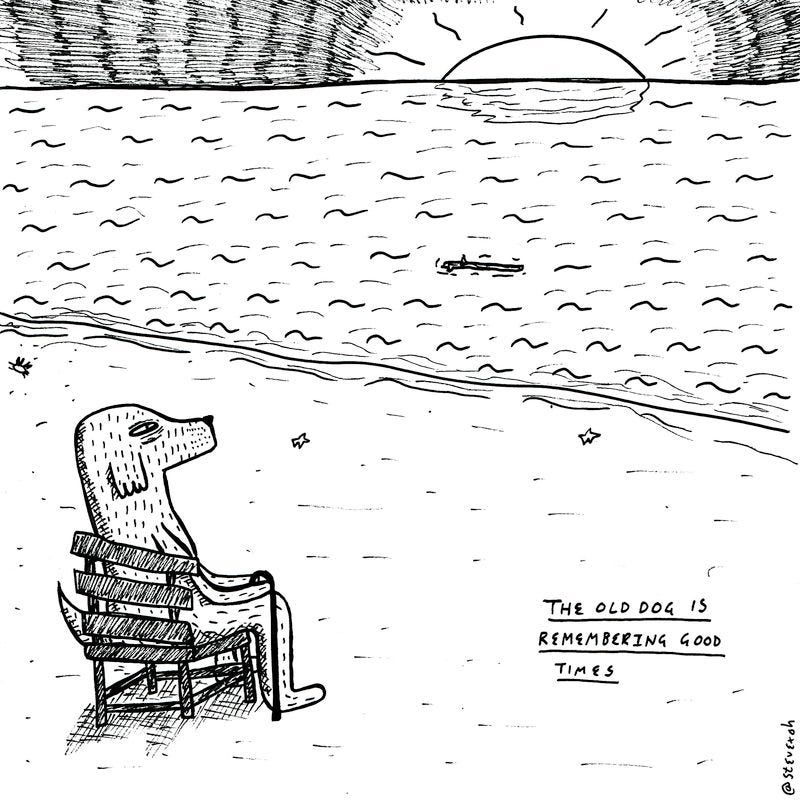
This Substack recently turned one and I inevitably found myself reflecting on what was happening in my life a year ago when I decided to start it. What was I thinking and feeling? What was occupying my mind? What was I excited about or anxious about? And what was going on in the world around me? But the more I reflected on all of this, the question that really began to fascinate me was where on earth I was retrieving all of these memories from.
I read a book called The Invention of Memory by Israel Rosenfield many years back and, ironically, had forgotten all about it until this moment. In the book, Rosenfield suggests that memories are not fixed representations of past events stored somewhere in the brain waiting to be retrieved, but are actively constructed in the present from the neural traces those experiences have left behind. Remembering is therefore less like replaying a recording and more like creating something new each time, shaped by our current context, emotions and everything that has happened to us since. This means that remembering is not a reliable window into the past, but a new experience created in the present that is unavoidably influenced by who we are now. But even though the act of remembering is a very here-and-now experience, we seem to find this incredibly difficult to conceive of, preferring instead to imagine memory as a load of stuff stored somewhere that we can retrieve.
What I find extra fascinating about all of this, is how human beings’ perception of memory has been shaped by the world around us and, in particular, the technology we have created. In a world of digital cloud storage, it is easy to think of memory as a vast database we can interrogate or access. But go back 30 years, when this technology didn’t exist, and the metaphor of the VHS video recorder greatly informed how we conceived of memory. As we trace back through history, we can get a sense of how the invention of photography, the printing press and the manuscript helped us make sense of this mysterious human experience of time travel. Even in ancient Greece, Plato suggested that memory was like a wax block in the soul in which impressions were left through our experiences. But, given what we now understand about the reconstructive nature of memory, all of these metaphors seem fundamentally flawed. Memory, it seems, is more like looking at the sea. We recognise it as the same sea each time we look, despite the fact that what we are actually experiencing is being created anew in that particular moment.
This brings to mind various occasions when my daughter told me of memories she has of things we did together when she was a young child, but I recall them very differently. It is tempting to say, “That’s not what happened”, but I’m now more wary of writing off our different recollections given that we are not accessing a concrete archive, but re-creating an experience in the moment. I recall similar things with my parents. I remember a number of occasions when my dad insisted that I had a crush on the Pretenders’ singer Chrissie Hynde when I was young. I have no recollection of that whatsoever and, whilst I remember finding people on the television attractive, I cannot find any trace of having those kinds of feelings directed towards Chrissie!
So, given how memory is essentially a present-moment experience, I’m left wondering what on earth the difference is between memory and imagination. Neuroscientists Donna Addis and Daniel Schacter proposed that remembering and imagining use substantially overlapping cognitive circuitry. Live and in the moment, we are able to reconstruct elements of past experiences as memories, or recombine those same elements into events that have never happened as imagination. Addis describes this shared underlying process as “constructive episodic simulation”.
Normally when I write this Substack, I like finding a way to go down a rabbit hole to explore things like this, cracking my mind open in the process but then finding a nice way to tie it all up to finish the piece. But I am stumped with this one as it has spawned so many sub-rabbit holes and makes me question, in a deeply curious way, how inaccurate my experience of anything other than the present moment might be. And, paradoxically, maybe that is the conclusion: to accept the flaws, inaccuracies and uncertainty inherent in our temporal human experience, be that how we remember the past or imagine the future.
Friedrich Nietzsche believed that forgetting wasn’t a failure of memory but an active and necessary human process that created room for something new. He suggested that “life in any true sense is absolutely impossible without forgetfulness”, implying that without forgetting we couldn’t properly inhabit the present at all. I like that, but also wonder if somehow his imagination had been overly influenced by the yet-to-be-invented metaphor of cloud storage capacity.
3. Workshops and events
Some workshops and events that you might be interested in coming along to.
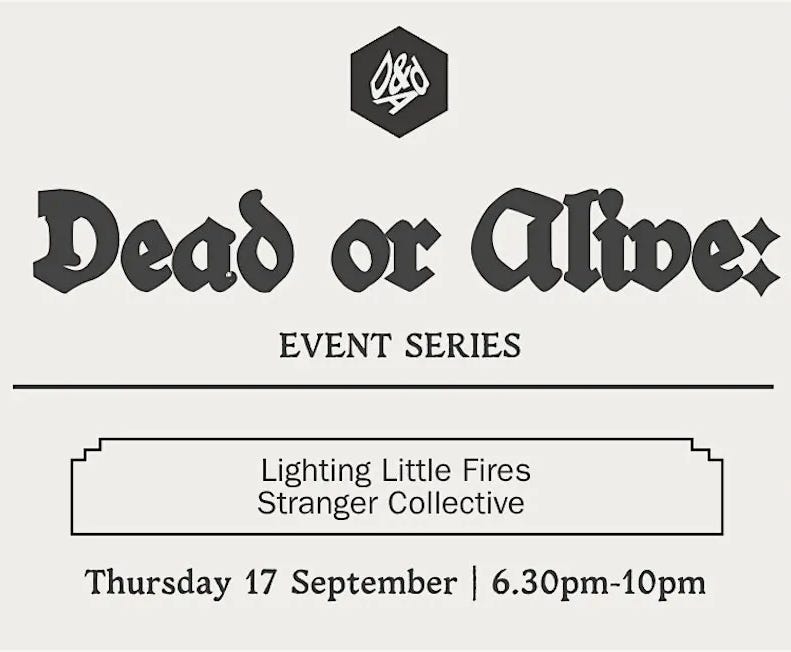
Lighting Little Fires - A stranger collective gathering
17th September 2026
Constantine, Cornwall
£25
I’ve been chatting with the lovely people at Stranger Collective for so many years about coming to speak at one of these events and am excited that I can finally make one!
This cosy gathering is described as flickering light, spitting wood, candid conversations around the flames. Real-world, real-time, real people gathering in small groups around multiple fires to listen, question, share – sparking creative energy across multiple corners of a twilight garden…
FIVE small fires.
FIVE speakers from different creative territories – some expected, some deliberately surprising.
FIVE x FIVE intimate, open conversations where everyone can speak, question, and share – moving between fires to mix things up and meet new people along the way.
I will be one of the five speakers telling stories around the fire. Would love for you to come and join me.
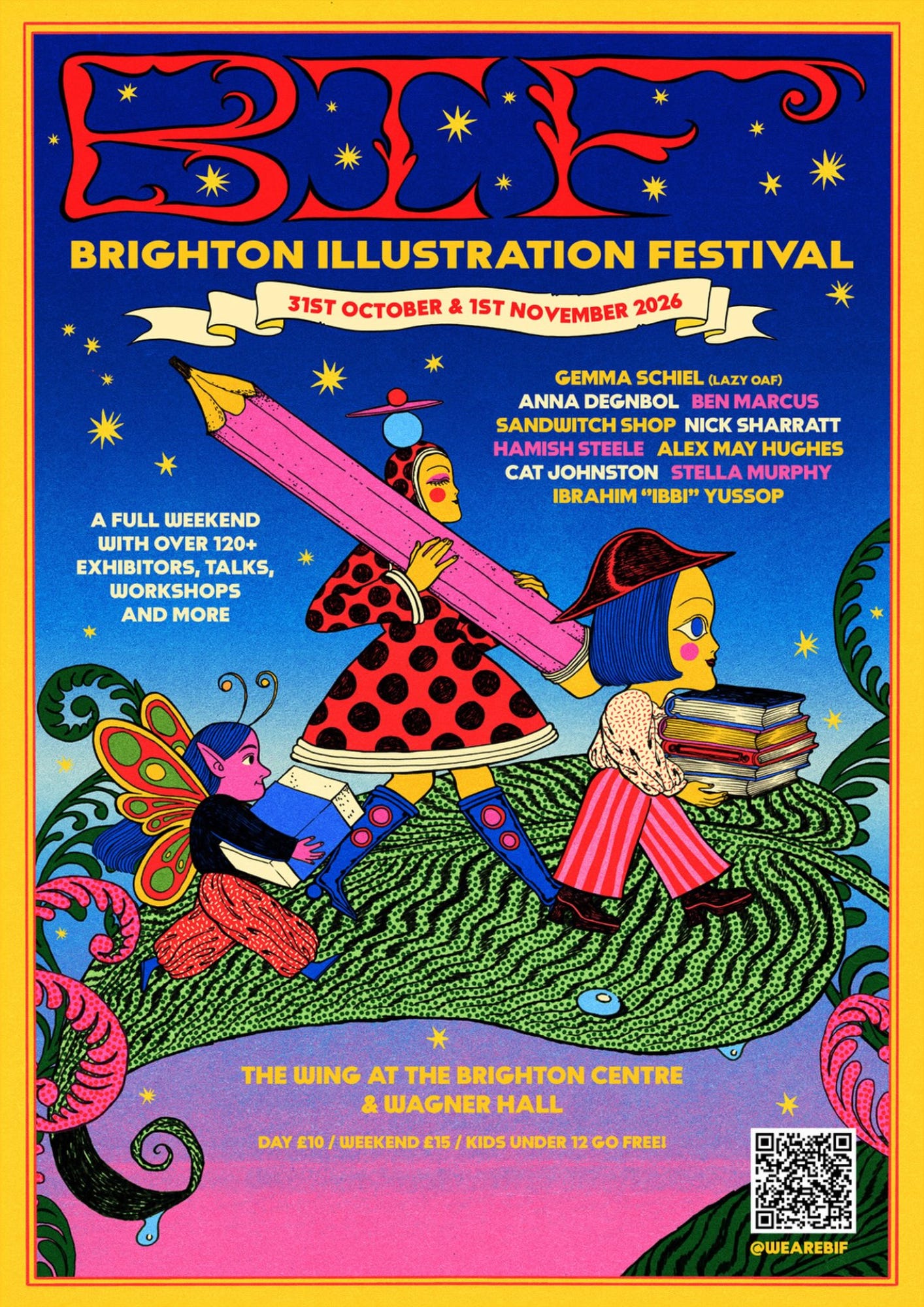
Brighton Illustration Festival
31st October + 1st November 2026
Brighton
Tickets from £10
I’m very selective about what markets/art fairs I do nowadays but have always wanted to be part of the prestigious Brighton Illustration Festival so am delighted that this year I will be.
I will be amongst a plethora of illustrators taking residence right by the sea in the Brighton Center and will be selling a wide range of prints, cards, t-shirts, stickers, books and more.
And at 12:15 on the Sunday I will be giving my Bingo Machine talk for any festival goers who would like to join me on a random collection of strange art stories.
So come spend a day by the sea with me and a hand-picked collection of amazing illustrators.
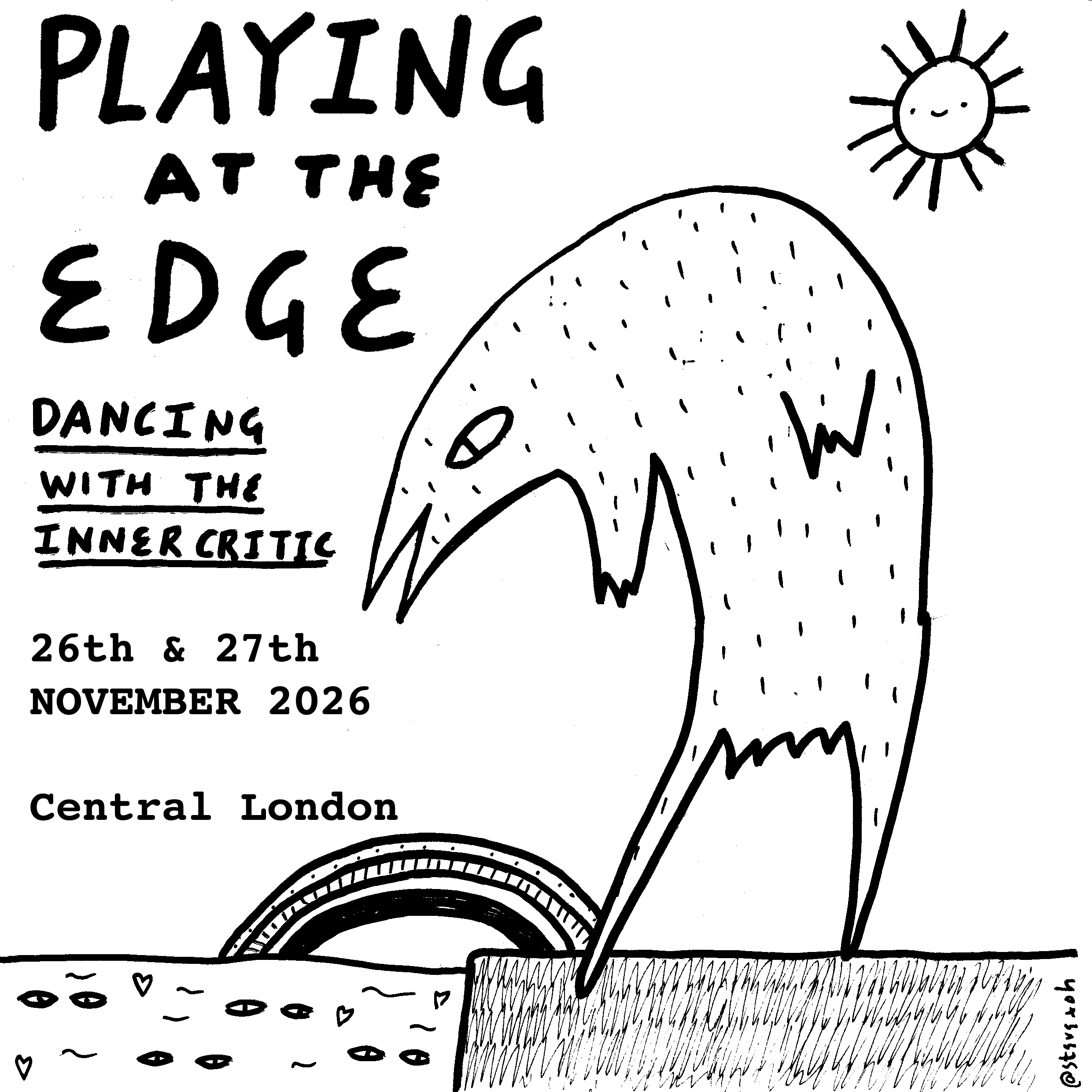
Playing at the Edge: Dancing with the inner critic
26th & 27th November 2026
Bloomsbury, London
£495 + VAT. Limited to 12 attendees.
I’m very excited to say that Simon Cavicchia and I have a date for our Playing at the Edge workshop. This two day workshop uses a variety of creative experiments to help us get to know and better understand our inhibiting idealised self images, our inner critic and the effect this has on realising our full creative potential.
Participants will be invited to participate in a variety of Gestalt Psychology techniques, creative practices, masks, improvisational experiments, mindfulness practices and a variety of other methods to help them become more aware of their attachments to fixed self images and other ways in which they inhibit their spontaneity.
If you’d like to know a little bit more about this work then you can watch my 2017 talk about dancing with my inner critic or read about “poster’s on the super ego’s bedroom wall” in Issue #7 of this Substack.
..:: MORE INFO AND TICKETS ::.

Mask Workshop
23rd October 2026
Bloomsbury, London
£145 + VAT. Limited to 10 attendees.
If you like what you read about masks issue #6 then is the workshop for you. It is my absolute favourite workshop to run. A day of using masks to explore parts of our personality that we have lost touch with or didn’t know existed. We will spend the morning getting to know different masks and the afternoon putting them in different playful and bizarre scenarios and situations.
Previous participants say:
“Simply the best workshop ever.”
“Possibly the most liberating experience you might ever have.”
“I’ll never forget the bits of me I met for the first time at the mask workshop.”
“Very weird. In a very, very good way.”
“A truly magical experience”
“It is like going home with a bunch of new friends inside yourself!”
To keep it playful and intimate the workshop is limited to just 10 places so if you’d like to come along the grab a place ASAP as they sell out quickly.
..:: MORE INFO AND TICKETS ::.
4. Grebo Guru prints and cards available
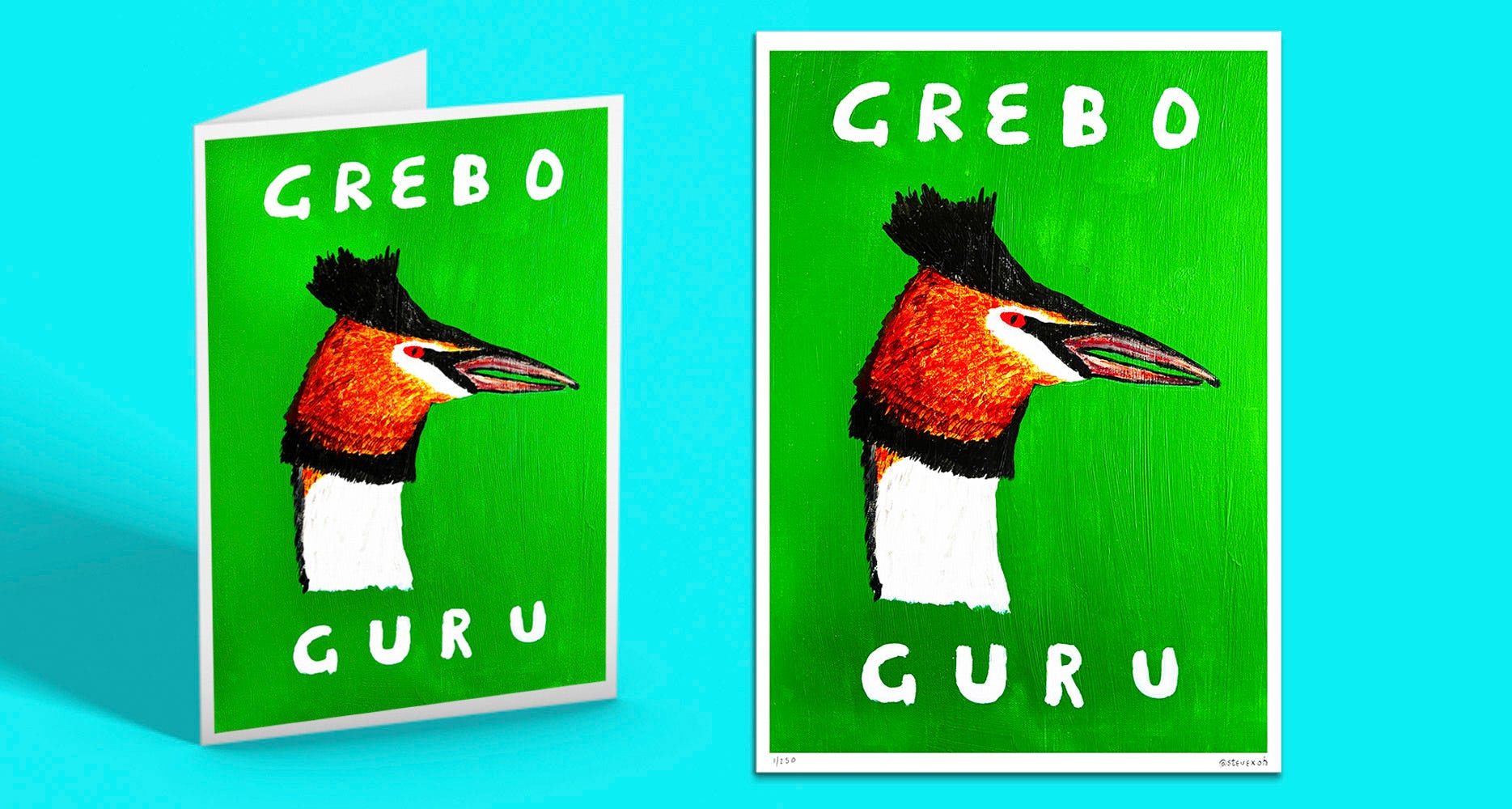
If you liked learning about grebes in this issue and want to show the world that you are a Grebo Guru then I have added a collection of cards and prints to my shop for you to buy.
.:: BUY GREBO GURU CARDS ::.
.:: BUY GREBO GURU PRINTS ::.
5. Analogious Joy subscription
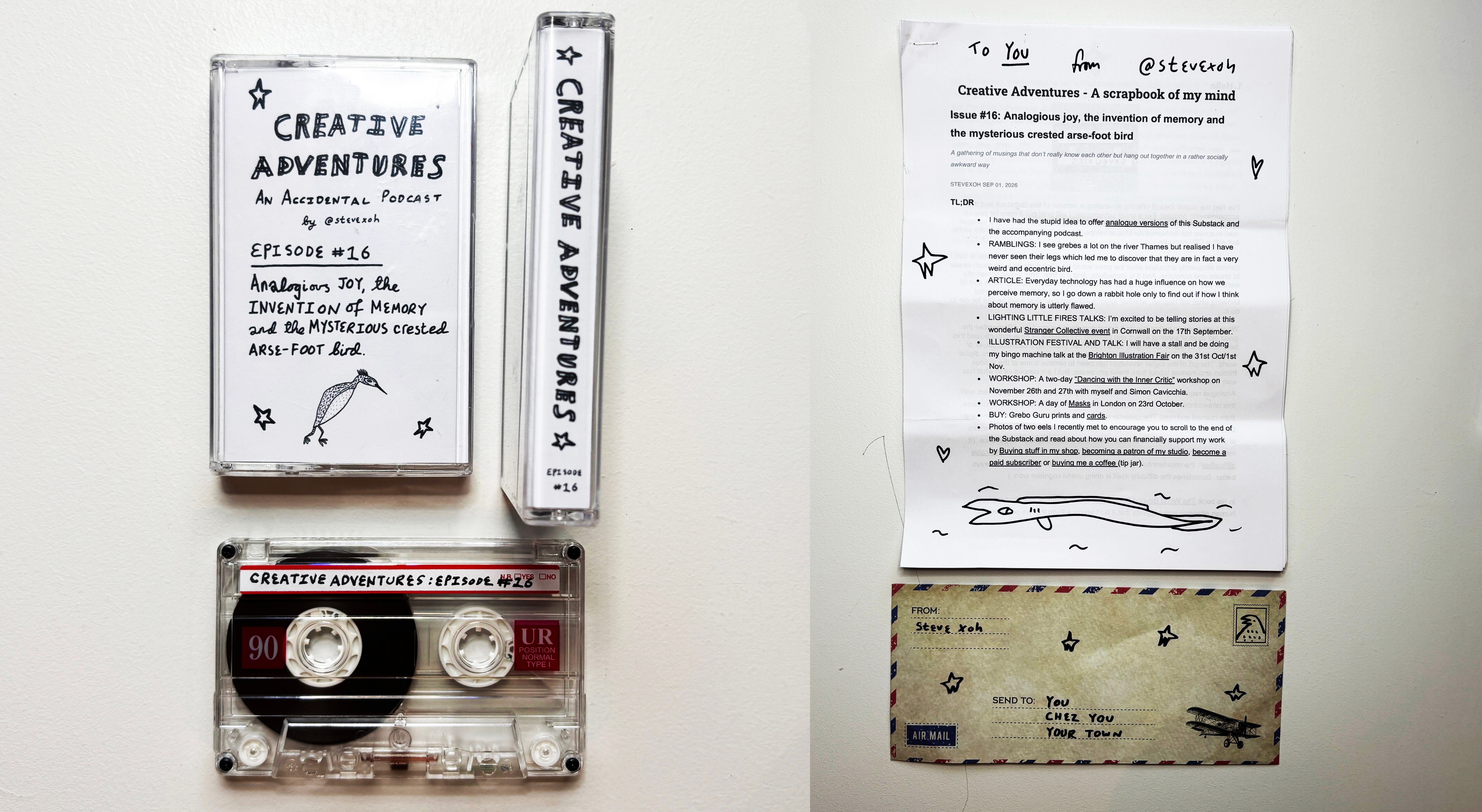
So, here’s some more details how you can get hold of analogue versions of this Substack (or the podcast version).
PODCAST (£15 per episode + free postage)
* Episode recorded onto a single C90 cassette in plastic case
* Custom printed cassette inlay featuring episode artwork
* Hand written cassette label
* Recorded on one side-only (unless episode longer than 45 mins)
* Cassettes: Maxwell UR C90
* Sent as Royal Mail 1st class Large Letter
SUBSTACK (£10 per issue + free postage)
* Edition printed on 100gsm white paper
* Hand-drawn doodles on each page
* Sent in a lovely, hand addressed, retro Air Mail envelope
* Approximately 8 - 10 double-sided pages per issue.
* Sent as Royal Mail 1st class letter
How it works:
* You can buy a single issue/episode or multiple issues/episodes in one go.
* If you buy a six month subscription then you will get one issue/episode free
* If you select NEXT RELEASE then I will send out the next episode to be released after you placed your order.
..:: BUY ANALOGIOUS JOY HERE ::..
6. Support my work
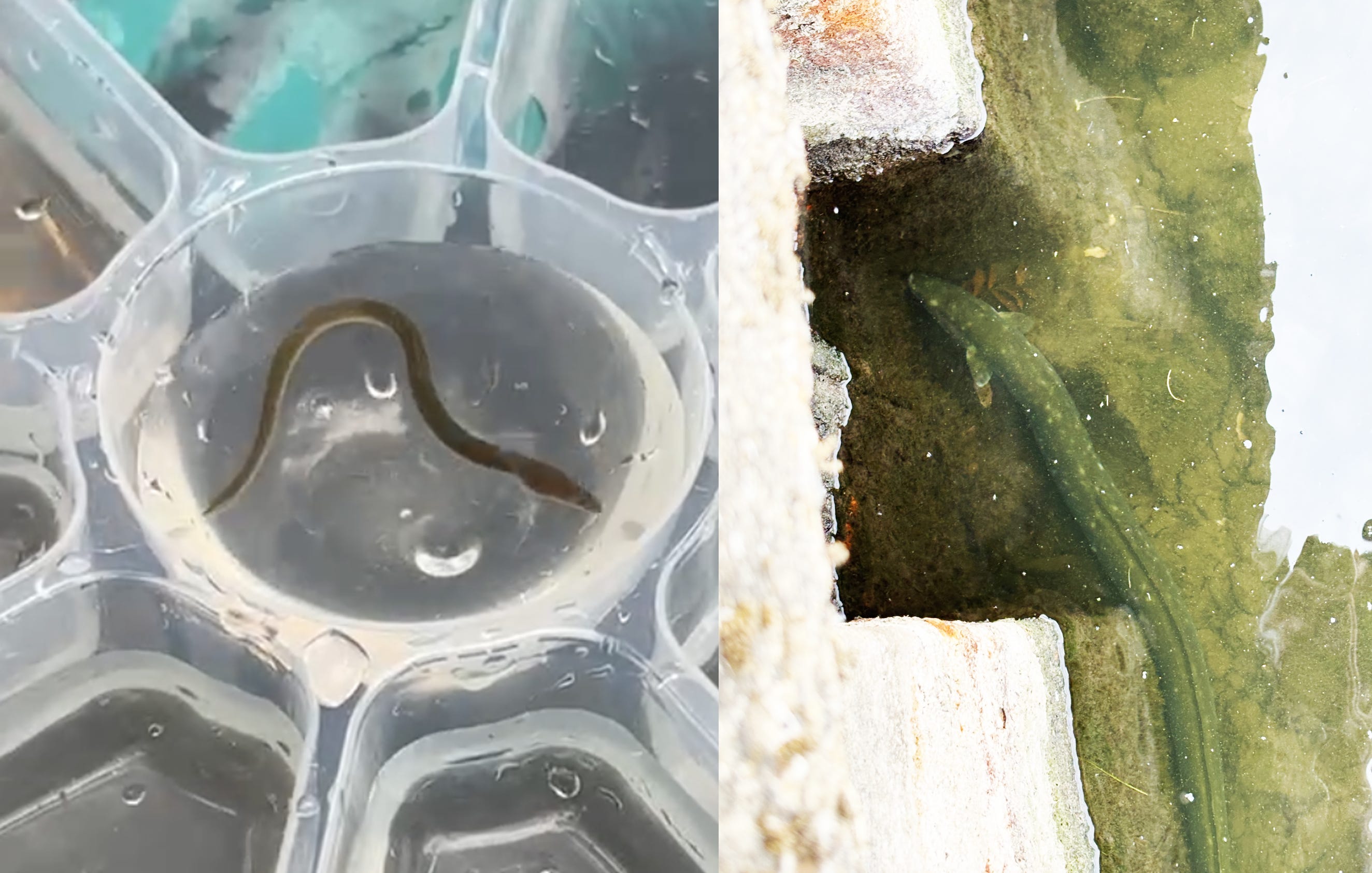
I recently did some Urban Riverfly Identification training as part of my ongoing work to monitor the health of the River Thames in the area where I live. It was whilst doing some net sampling for tiny riverfly larvae that I accidentally caught an elver - a juvenile eel. As a huge eel fan, this was an absolute joy as I have never seen an elver before.
And, as if that wasn’t enough, the next day whilst walking to the studio I spotted an adult yellow eel in the river. Sadly it seemed to be struggling, possibly due to the very low water level and increased water temperature reducing the oxygen.
I don’t think I’d seen an eel since I was a kid, so this felt like a strange serendipity, encountering two very different life stages of the same species that I recently featured on a popular t-shirt.
I want this Substack to be free and accessible for everyone irrelevant of financial means (the podcast version too) and this is an important principle in much of my work. When I do charge for things, like art or workshops or events, I strive to do so in a way that doesn’t exclude those who do not have the financial means to participate.
So, when people do support my work financially it means so much and helps me continue to work in this way and do things like spend a month making a mask out of a water bottle just because it fits on my head.
If you can afford to do so you can support my work in a number of ways, be that buying me a coffee from £1, buying some art from my shop, becoming a patron of my studio or becoming a paid subscriber to this Substack. (And if you can’t afford it then I absolutely love you getting this for free.)
Buy some art from my shop. I have a big selection of prints, original art, books, badges, t-shirts, posters and more.
.:: VISIT MY SHOP HERE ::.Become a patron of my studio. For a one-off donation of your choice you become an official patron with a badge, a certificate, a behind the scenes blog and your name added to the scroll of honour in the window of the studio.
.:: BECOME A PATRON HERE ::.Buy me a coffee from £1. Like a tip jar.
.:: BUY ME A COFFEE HERE::.Become a paid subscriber of this Substack. I didn’t even know this was an option until a few people spontaneously did it! You don’t get any extra content or anything but you do get my eternal gratitude!